Onboarding with Sage Network
The onboarding process has 3 steps:
-
Create a Sage Network environment that is securely connected to Sage X3.
This cloud environment, or tenant, is where company, customer, supplier, invoice, and status data can be synchronized for inbound and outbound flows.
The Sage Network tenant is managed at company level, as defined in Sage X3. This lets you deploy electronic invoicing company by company.
For electronic invoicing, a single tenant can be associated with multiple electronic addresses, as defined in the electronic directory.
Note - informationThis step is described in the Create a Sage Network environment section . -
Connect to the Sage PA Test Platform for testing or to the Sage Approved Platform for production.
Note - informationThis step is described in the Connect to the Sage Approved Platform or Sage PA Test Platform section. -
Update the access point.
Note - informationThis step is described in the Update the access point section.
This process applies to France.
For Germany, you only need to create companies and register them with Sage Network to use the document transformation service.
Prerequisites
The SN -Sage Network activity code needs to be active. This enables the Companies function described in the onboarding process below.
The administrator performing onboarding needs to have a Sage ID account. Sage ID is the Sage application used to authenticate a user of a Sage solution.
There are two ways an administrator can create a Sage ID account:
Connect to Sage X3 with Sage ID
This requires setting up a Sage ID server in Administration > Administration > Authentication > Sage ID servers. You can choose whether or not to include it in the connection window, which is the solution recommended by Sage for onboarding.
Open a Sage ID login window
If an administrator is not logged in with a Sage ID, the onboarding process includes opening a Sage ID login window.
Create a Sage Network environment
The process includes several steps.
Manage your organization
Open: Administration > Administration > Connected services > Organizations
You need to make sure that the organization is already created. Only one organization is required.
The organization is needed for Data, Clean, and Control, e-invoicing, and AP Automation.
Manage companies
Open: Administration > Administration > Licenses > Companies
This step creates the Sage Network tenant used to connected to the Sage X3 company. You need to do this for each company you want to onboard.
You can create test companies for testing purposes. Test company data is not shared with the PPF or the Public directory.
To create a company:
- Select New company.
- In Organization, enter a unique name, and select the relevant endpoint.
- In X3 company code, select the company you want to register.
-
In the E-invoicing block, the Test company checkbox is selected by default.
Leave it selected to create a test company and connect it to the test platform. This is important if you want to perform test and not send any data to the public websites.
To create a production company, clear the Test company checkbox.
Note - warningYou cannot change a test company to a production company, or a production company to a test company, after it has been created. - Save the record.
To register a company:
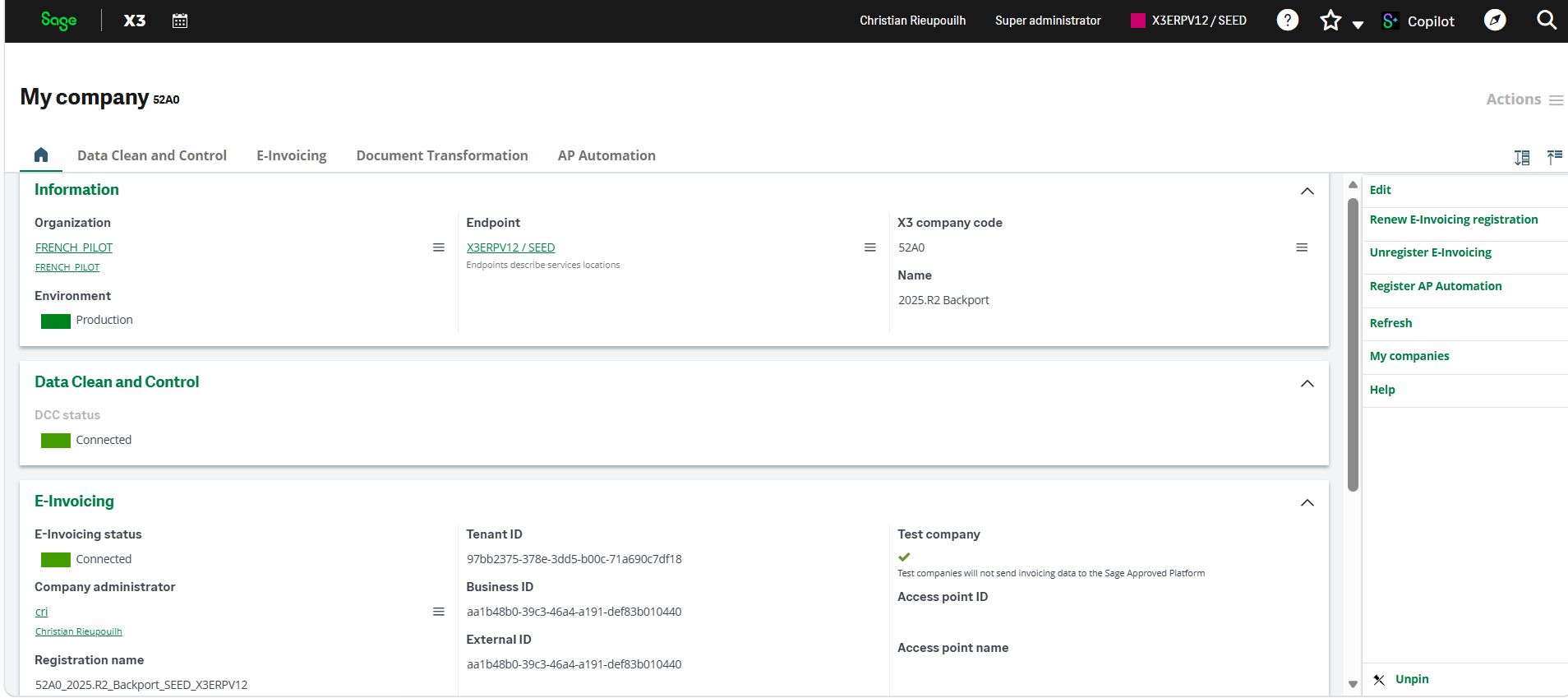
- Select Register E-invoicing. This action configures the tenant for inbound and outbound electronic invoicing.
- If you are already logged in with Sage ID, the onboarding runs in the background and a consent window opens. Make sure pop-ups are allowed.
- If you are not logged in with Sage ID, the Sage ID login window opens. Log in with your Sage ID.
- Save the record.
When the process is complete, the company, or tenant, is created in Sage Network with the following details:
- Tenant ID
- Business ID / External ID
- Registration name
- Status (Connected)
- Tenant expiration date
- Test flag, if the company was created as a test company
This step also activates Data Clean and Control. The status shown is Connected.
To unregister and delete a company:
Before deleting a company, unregister it by using the action Unregister E-invoicing.
To renew a company:
If the registration token is expired, use this action to renew it.
Synchronize company, customer and supplier data
Open: Declarations > Sage Network > Synchronization > Data Sync (SNSYNC)
This step synchronizes the tenant with the Sage X3 company. It also synchronizes customer and supplier data.
The export template you chose determines the type of data to be processed. Each synchronization applies to a single company, as defined in Sage X3. You need to synchronize customers and suppliers for each company onboarded in Sage Network.
You can choose to extract data to a file or chain the extraction and send it directly to Sage Network by selecting Sync with Sage Network.
3 mandatory templates are used for e-invoicing:
- SNCPY - Company sync model
- SNBPC - Customer sync model
- SNBPS - Supplier sync model
Other templates are delivered but are not used for e-invoicing at this stage.
The export template you choose determines the type of data to process.
First, synchronize companies using the SNCPY – Company sync model template. Each synchronization applies to a single company, as defined in Sage X3.
Then synchronize customers and suppliers for each company onboarded in Sage Network.
You can extract data to a file, or extract and send it directly to Sage Network by selecting Sync with Network.
Synchronize a company
When you synchronize a company, the system synchronizes:
- The company identifiers, such as SIREN and SIRET for French companies, and EU VAT number.
- The company addresses, including SIREN, SIRET, routing code, or suffix for French companies, as defined in the company legal data.
- The company category: Production or Test.
- Select SNCPY- Company sync model. Do not modify the template.
- Sync with Network and All created and updated are selected by default.
- Enter the company code.
- Select OK to sync the data for this company with Sage Network.
- A log file opens.
Synch customers and suppliers
The Data Sync (SNSYNC) function is also used to synch customer and supplier data, using the SNBPC - Customer sync model and SNBPS - Supplier sync model templates.
Connect to Sage Network
The next step is to connect to the network at this URL: https://network.sage.com/app
- Log in to the Sage Collaborative Portal using the Sage ID that you used to create the tenant.
- If synchronization is still in progress, wait until it is complete.
- When synchronization is complete, select the company you want to finalize from the list of onboarded companies and follow the process to update the required information.
- The company is then onboarded to Sage Network.
Identify test and production companies
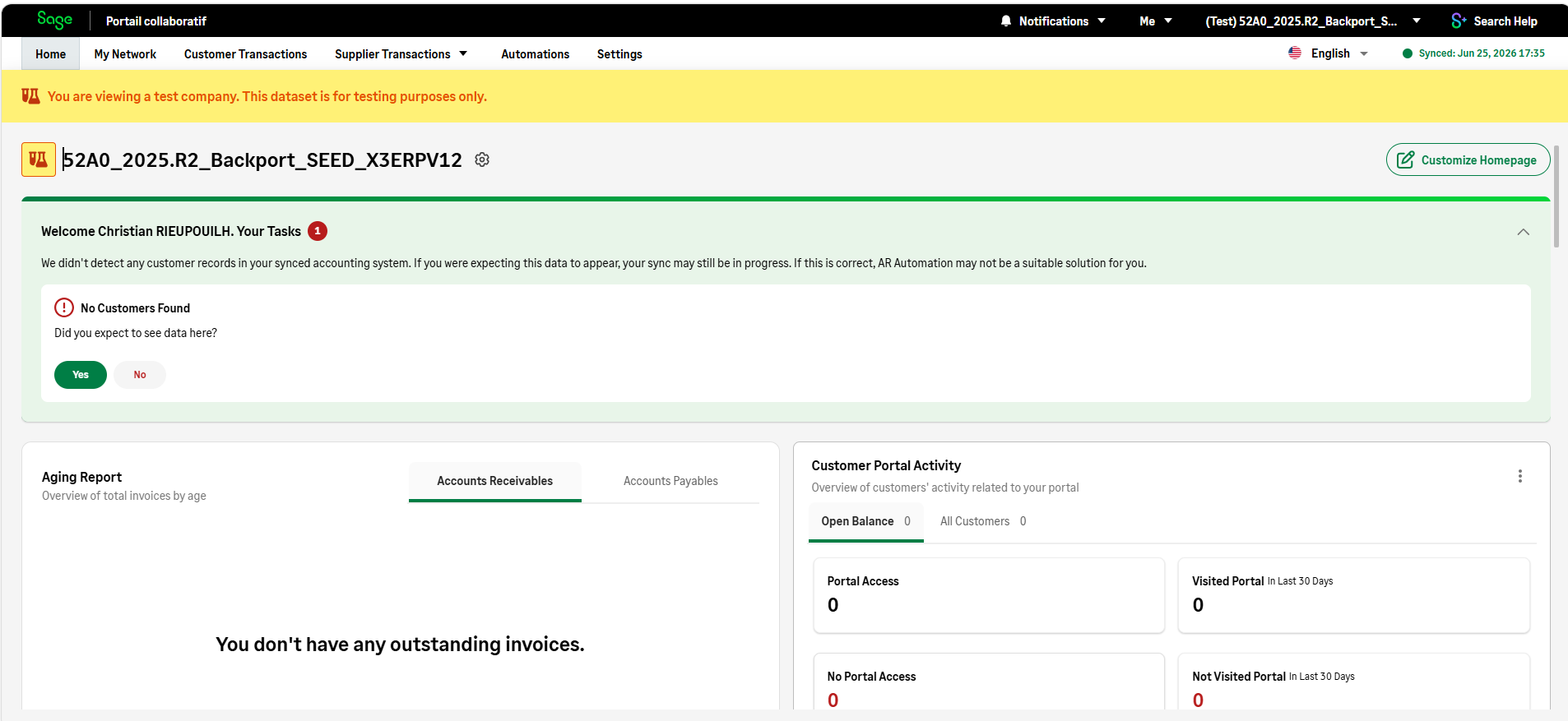
In the Sage Collaborative Portal, a test company, or tenant, is identified with a yellow lab icon.
When you select a test company, or tenant, from the top bar, a yellow banner identifies it as a test company.
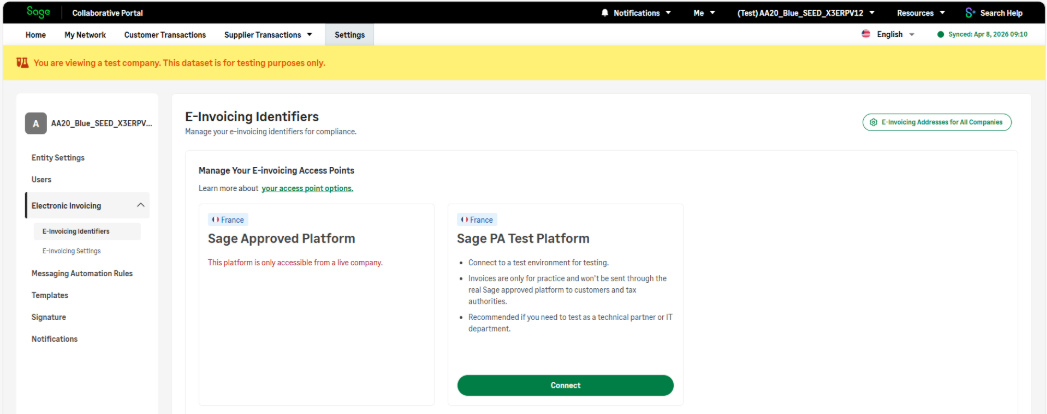
Under Settings > Electronic Invoicing > E-Invoicing identifiers, only the Sage PA Test Platform is active for test companies. The production Sage Approved Platform is not active.
Connect to the Sage PA Test Platform or Sage Approved Platform
Connect to the Sage PA Test Platform for testing or to the Sage Approved Platform for production to declare electronic addresses in the Public directory.
Production and test platform explanation
-
The Sage PA Test Platform has been created for testing. Define companies as test companies and connect them to the Sage PA Test Platform to test connector behavior, network notifications, and mock flows.
The test platform does not perform UBL/XML validations, such as Schematron checks.
You can declare electronic addresses, but data is not shared with the PPF or the Public directory.
- The Sage Approved Platform is the production platform. Only connect real production companies to the Sage Approved Platform. Production data is shared with the PPF and the Public directory.
Declare electronic addresses in the Public directory
Go to Settings > Electronic Invoicing > E-Invoicing identifiers, and connect to the test or production platform, depending on your needs.
When you are connected, the displayed addresses are the addresses set up in the legal data of the Sage X3 company and synchronized using the Data sync process with the SNCPY – Company sync model template.
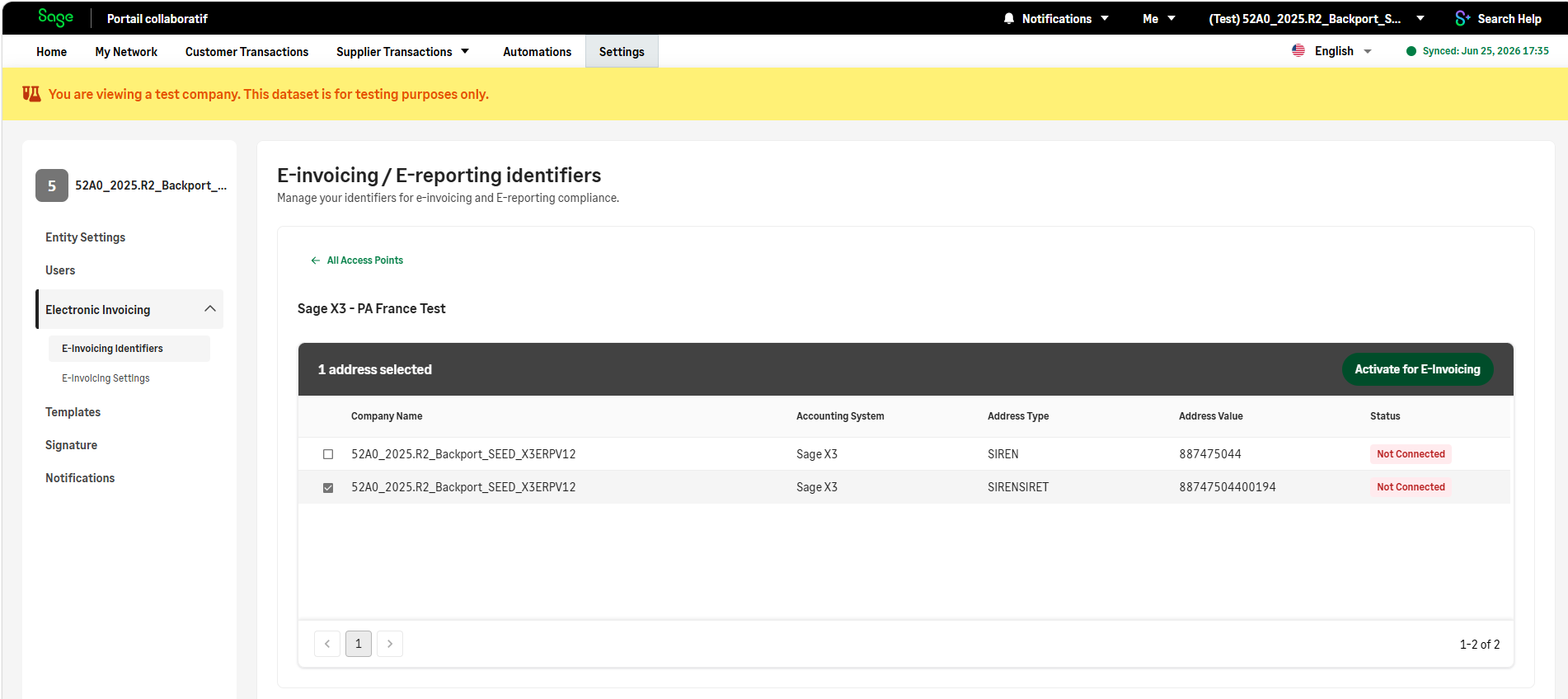
- Select the addresses you want to declare.
-
For production companies only, select the appropriate Usage option:
- All: Use the electronic address for all purposes.
- Sending Only: Use the electronic address only to send e-invoices.
- E-reporting Only: Use the electronic address only for e-reporting.
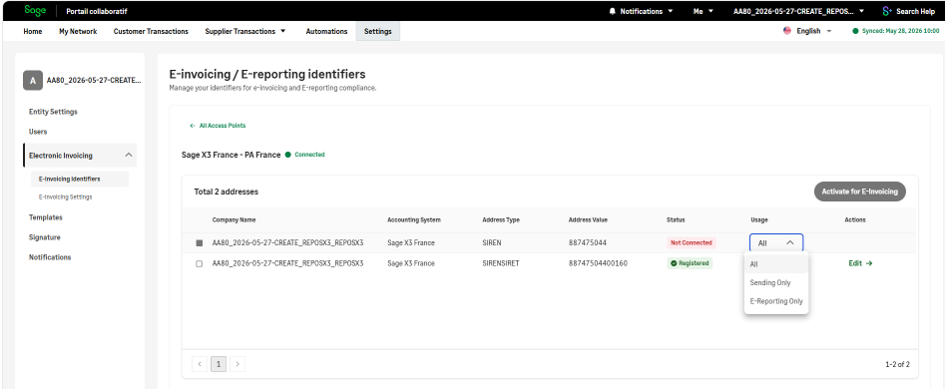
- Select Activate for E-invoicing.
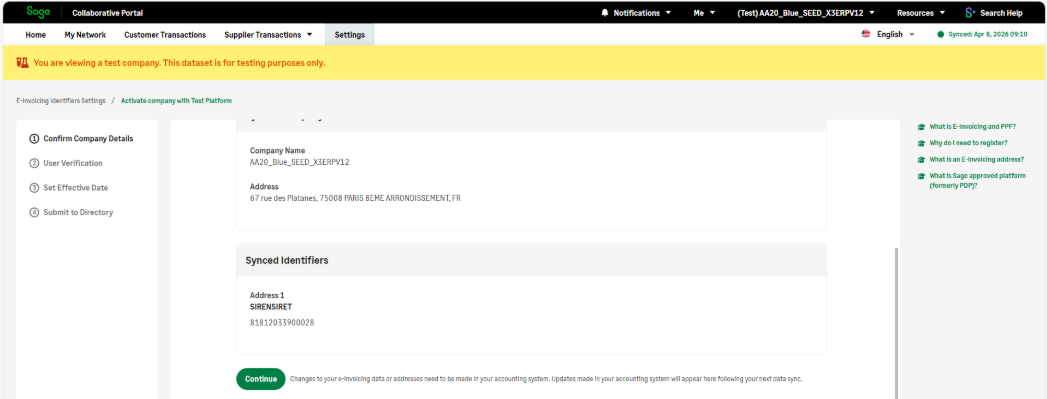
- There are 4 steps to complete:
- Confirm Company details.
- User Verification.
- Set Effective Date. This is the date from which the address is active in the Public directory and can receive invoices. By default it is set to the 1st of september 2026. If you’re part or the pilot session, you can select a earlier date.
- Submit to Directory.
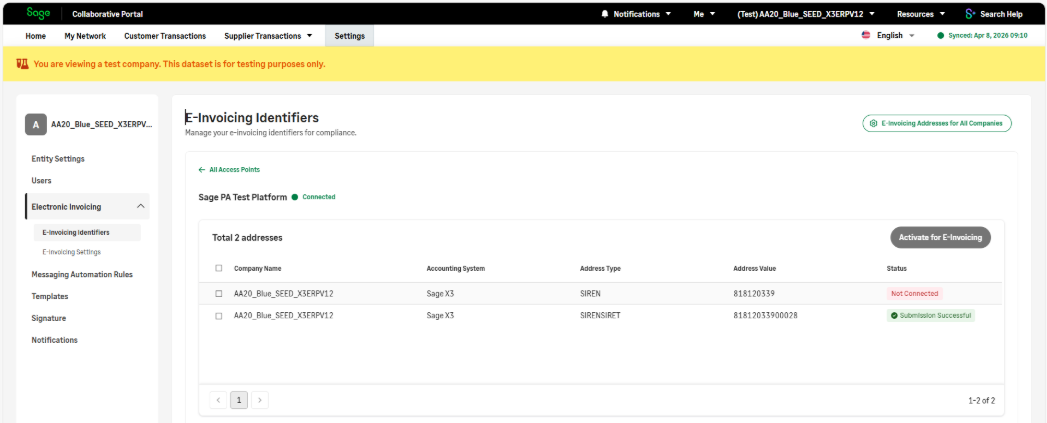
When the declaration process is over for an address, status Submission successful displays for the address. The company can now receive invoices to the addresses declared in the platform.
Update the access point
Open: Declarations > Sage Network > Synchronization > Monitoring > Get synchronization tasks (SNGETSYNCID)
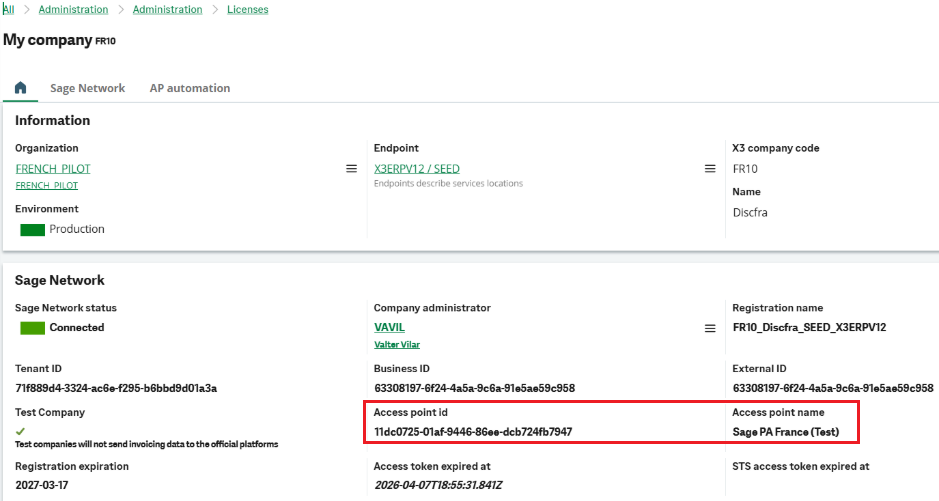
To finalize onboarding and send invoices, retrieve the Access point ID and Access point name from Sage Network and synchronize them with Sage X3.
Use the Gest synchronization tasks function (SNGETSYNCID).
A log file opens when the task is complete.
In Sage X3, go to Administration > Administration > Connected services > Companies and check that the Access point ID and Access point name are displayed.
- For test companies, the access point name is Sage PA France (Test).
- For production companies, the access point name is SAGE PA France.