Electronic signature and software certification
All customer invoices must have a digital signature. You can generate an audit file that follows the SAF-T PT standard to meet this requirement. The Standard Audit File - Tax (SAF-T) is a standard for audit purposes established by the Organization for Economic Co-operation and Development (OECD). SAF-T PT is the Portuguese version of the SAF-T standard.
Sage X3 is in compliance with software certification regarding several laws, such as laws 197/2012, 198/2012, 160/2013, 161/2013, and law 22-A/2012 from 24 January regarding mandatory requirements for January 2013.
One of the requirements to obtain this certification is to generate a digital signature for all the logistic documents issued to customers and suppliers.
This electronic signature is based on the RSA asymmetric cipher algorithm that contains a private key provided by the software company and a public key provided to the government.
The following document types need to be digitally signed:
- Invoices
- Delivery notes
- Returns for sales and purchases
- Any other document that can serve as a transport document accompanying the materials such as intersite transfers, subcontract transfers, and subcontract returns.
The digital signature must guarantee that the following data is not changed after the document is issued and validated:
- Creation date and time
- Modification date and time
- Document amount
- Document number
Digitally signed documents cannot be deleted and for each document type must have a dedicated sequence number.
There are other records that, although not being digitally signed, are required to be issued with the same specific needs of the above documents that are digitally signed because they are also exported in the SAF-T file:
- Payments and receipts
- Sales orders
- Customer quotations
- Pro-forma invoices
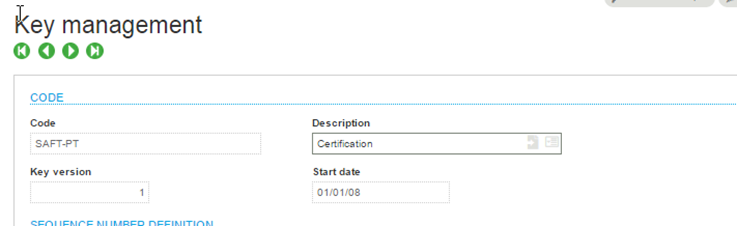
Set up key management
It is recommended to verify that the key version is properly created as follows:
Set up sequential numbers
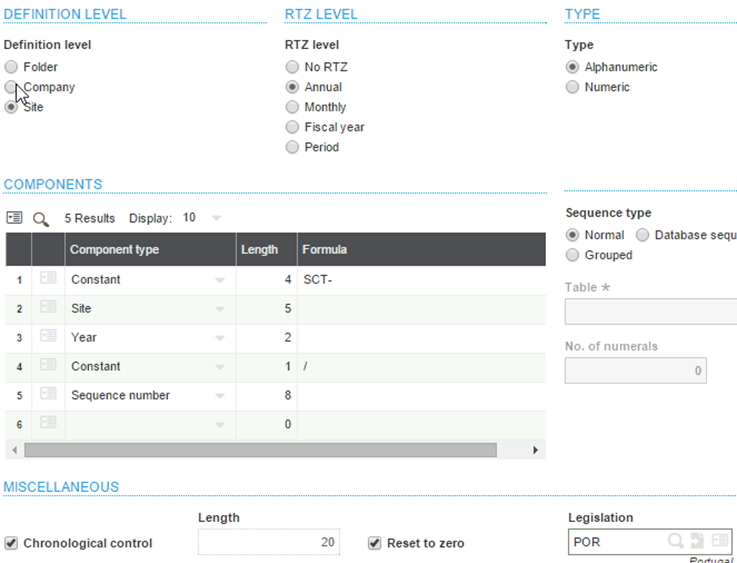
The sequential numbers submitted for electronic signature and exported to SAF-T need to have a specific structure because it is required to easily distinguish the serial number of the sequential number (alphanumeric structure) from the sequential number itself (numeric structure). These 2 parts must be divided by a slash (/).
Therefore, the following setup needs to be respected:
Common controls
- The last part must be the sequential number.
- The penultimate part (before sequential number) needs to be a slash ("/"’).
- It must be chronological.
- The definition level can be Folder, Company or Site. But only the chosen element can belong to the counter structure (None, Company or Site).
- The initialization level can be No RTZ, Annual or Fiscal year. Only the chosen element can be part of the structure (None, Annual or Fiscal year).
- The elements Month, Week, Day, Period and Formula are not allowed.
For invoices
- The sequential number code must match with the document type; you can add the a "PT" prefix.
- The first part of the structure, which is a constant element, must match the document type.
Example of a correct structure: