
Processing credits to receive at fiscal year end
The objective of this step is to automatically post credit memo receivables (CMRs) from supplier return lines that cannot be invoiced, partially invoiced, or pending a credit memo. You can do this at the end of each month, quarter, or fiscal year to generate recurring CMRs.
If a return has been posted at the end of month N and has not been the object of a credit memo during month N+1, a new CMR is generated at the end of month N+1 for this return line. This process considers not posted (not submitted to a CMR) and not invoiced returns, as well as posted but not invoiced returns linked to a CMR whose reversal date is prior to the new creation date.
You can perform this step before or after:
- Closing or carrying forward not closed purchase requests and orders.
- Carrying forward not closed precommitments and commitments.
CMRs generated from not invoiced returns do not take order footers into account.
Function overview
Open: Financials > Closing processings > Credits to receive
In this function, you can:
- Select the returns to process.
- Specify the expected accounting generation type.
Function
Credit to receive (FUNPNH)
Parameters
FRADGI – French fiscal regulation (TC chapter, CPT group)
GAUPNH – Credits to receive journal (ACH chapter, INV group)
TYPACC – Simulated journal type (TC chapter, INV group)
Prerequisites
Creating CMRs implies that an approved envelope, budget and budget line, which correspond to the original envelope of the order, exist in the new fiscal year.
For multiannual envelopes
The envelope and budget must exist. The budget must contain an 'Approved' budget line with the same characteristics as the original budget line of the order.
In the opposite case, the creation of the CRM is rejected and signaled by a message in the log file.
For annual envelopes
It is possible the envelope may not exist. The envelope exists if it has been created by renewal or by Carry-forward of not closed commitments (if they have been created before the process of CMRs).
If the envelope does not exist in the new fiscal year, creating the CMR is impossible. The following warning message displays "Validity limit exceeded, envelope not renewed."
If the envelope has been created by renewal or carry-forward, creating the CMRs results in a search for the envelope code. Secondly, it searches in the envelope for a budget and a budget line set to Final and equivalent to the original budget line.
If all these elements exist, the CMR is generated. In the opposite case, the creation is rejected and the reason is noted in the log file.
Selecting credits to receive
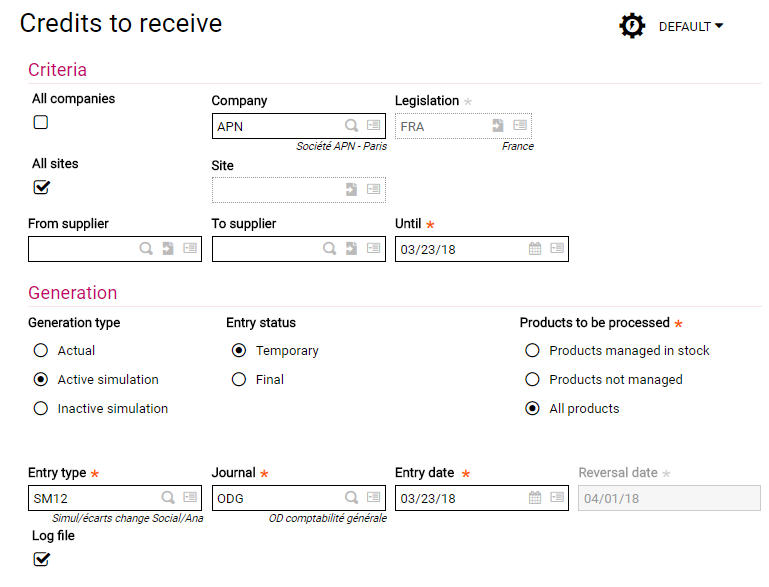
Enter the selection criteria.
All companies
If you select this check box, the process includes all the companies in the folder.
In a multi-legislation environment (LEG activity code active), the box is cleared and disabled. The process can only be launched company by company because the document type and the entry journal are potentially for one legislation.
When you clear this check box, you must enter or select the company code to which the process applies.
All sites
If you select All companies, this check box must be selected. If not, and you select All sites, the process includes all the sites associated with the company.
If you don't select All sites, you must enter a site code for the selected company.
From supplier / To supplier
Enter a supplier range to limit results to those suppliers.
Until
You can choose a return date up to which recordings are selected.
Accounting journal entry generation type
You then need to specify the CMR posting terms.
Generation type
Choose between the following generation types:
Actual
An actual accounting journal entry can be inquired and printed (GL, Balance, etc.). Then, you can decide if the status of this actual journal entry is temporary or final.
A return processed by an actual journal entry is considered to be fully posted. It can only be considered again once the reversal date is exceeded. In this case, a reversal journal entry for the credit to receive will be generated automatically on reversal date.
If the processed return is based on a receipt which originated from an order, and if Commitment management is enabled, a commitment will be carried out on the credit to receive date for the processed lines; a 'decommitment' process will be carried out as well on the reversal date of the credit to receive.
Active simulation / Inactive simulation
In the case of an active simulation, a simulation journal entry is also integrated to inquiries and prints. It can be converted into an actual journal or deactivated in order to become an inactive simulation journal (i.e. not displayed in inquiries and reports). To ensure consistency, a simulation journal entry which originated from a supplier return should not be converted into an actual journal entry as the link may not be maintained. A return processed by a simulation journal entry is not considered to be posted.
It is possible to first, generate the journal entry in simulation mode, then relaunch the process in actual mode. In this case, the simulation journal entry is automatically deleted and replaced with the actual journal entry that will take into account any new not invoiced return.
Open: Financials > Current processes > Simulations > Post
Entry status
When generated in Simulation, the journal entry must be Temporary.
When generated in Actual, you can set the journal entry status to Temporary or Final. This status means that the journal entry can be modified:
Most Temporary journal information can be modified depending on the nature and origin of the accounting document:
-Temporary payment document: bank line cannot be deleted
-Purchase invoice document: BP line cannot be deleted, purchase account and VAT can be modified,
Management events that affect the accounting document:
-Charge account with a declared VAT amount
-Matched, or not, VAT account
Once the journal is Final, the only elements that can be added to it are for information purposes only or concern analytical allocations. The date, amounts, accounts, VAT code and other accounting information can no longer be modified.
Products to be processed
All the products and therefore all the return lines are selected by default. You may choose to only include the products managed in stock, or to include only the products not managed in stock.
Entry type
This is the entry type that will be used to generate the credits to receive and their reversals. The entry type matches the entered entry: customer invoice, miscellaneous operations, collection, etc. The entry type sets the management rules for VAT, reminders, etc. It is one of the key elements when creating an accounting entry.
When the journal entry is generated in Actual mode, the entry type is initialized by the one entered on the PNH automatic journal entry. You can modify it.
When the journal entry is generated in Simulation mode, the entry type originates from the parameter defined at folder level: The TYPACC — Simulated journal type (TC chapter, INV group) —parameter can be modified.
Journal
Enter the accounting journal code (1 to 5 alphanumerical characters) used to save the journal.
It is initialized by default as follows:
When the journal is generated in Actual mode, the journal entered on the PNH automatic journal is used. If it is not specified on the entry, the journal associated with the journal entry type is used by default.
When the journal entry is generated in Simulation mode, the journal associated with the journal entry type is used.
You can modify it, but the entry of an unauthorized journal code at entry type level is prohibited.
Entry date
Specify the entry date which corresponds to the Credit to receive. This date must belong to a fiscal year and period open for all ledger types. By default, it is the current date.
Reversal date
You can specify a reversal date for the journal entry only if it is generated in Actual mode. In this case, the process of invoices to receive generates two entries: one corresponding to the credit memo to receive and the other to its reversal.
The reversal date submitted by default corresponds to the first day of the next accounting period. In a standard operating framework, credits to receive are generated at the end of the month and reversed at the start of the next month in order to have an end-of-month situation for the returns that have not been invoiced yet.
If there is a tracking of commitments at order level (in relation with the receipts of processed returns), these will be committed with a credit to receive date and reversed on reversal date in order to have a balanced budget situation for each accounting period.
Log file
This check box is selected by default and is used to display, at the end of the process, a summary of all journal entries generated by Company, Site and Supplier (credit to receive, credit to receive reversals, commitment journal entries, commitment reversals), as well as the various tax-excluding or tax-including totals by Company and Site, with a valuation for each return line processed. You can clear this check box.
Credits to receive process description
The generation process of credits to receive is launched by validating the entered parameters by clicking OK.
This process always relies on the PNH automatic journal. However, two automatic journal entries are delivered:
- PNH generates credits to receive with taxes.
- PNH1 generates credits to receive without tax.
If you want to use the PNH1 automatic journal entry PNH1 instead, it will be necessary to delete or rename the PNH automatic journal entry and then rename the PNH1 automatic journal as PNH.
You can generate a credit to receive by return, or a credit to receive by combination of: Company, Site, Supplier and Currency, according to the option Grouping selected in the PTH automatic journal entry header:
- One journal entry per line: creation of a credit to receive by return
- Grouped journal entries: creation of a credit to receive by combination
Creation rules of credits to receive
Create IRS before the carry-forward of purchase lines:
If the credits to receive are created before the carry-forward of unclosed purchase lines, the creation of credits to receive carries out the following on the relevant fiscal year:
- The creation of an expense equal to the credit to receive amount,
- The creation of a commitment line equal to the credit to receive amount.
Create credits to receive after the carry-forward of purchase lines:
If the credits to receive are created before the carry-forward of unclosed purchase lines, the order line has been fully decommited (received + not received), meaning the creation of credits to receive carries out the following:
- The creation of a negative expense equal to the credit to receive amount on the accrual fiscal year.
- The creation of a commitment line equal to the credit to receive amount on the following fiscal year.
Credit to receive reversal:
Regardless of the creation time (before or after the carry-forward of not closed purchase lines), the credit to receive reversal on the following fiscal year carries out the following:
- The cancellation of the negative expense,
- The creation of a decommitment line.
Annual envelope number update rules
Generally, the update of the new number of the annual envelope is carried out in purchase documents (order lines, receipts) with the carry-forward of commitments.
In the examples below, the return slip is updated with the new dimension number (CPTANALIN) when no carry-forward has been performed:
- Execution of the IR process on current fiscal year end (FUNPTH).
- Date on a fiscal year superior to the envelope fiscal year (in the credit to receive reversal).
- The ordered quantity of the order is equal to the invoiced quantity.
Canceling a validated return
You can cancel a validated return by entering a new or miscellaneous receipt (this triggers a stock reintegration).
It is also possible to modify the return to cancel the credit to receive.
Examples of credits to receive creation rules
Create credits to receive before the carry-forward of unclosed commitments:
| Credits to receive before carry-forward of commitments |
Amounts | BL N | BL N+1 | ||
|---|---|---|---|---|---|
| Committed | Achieved | Committed | Achieved | ||
|
(1) Order |
100 |
100 |
|
|
|
|
(2) Receipt |
80 |
|
|
|
|
|
(3) Invoice on receipt |
90 |
-90 |
90 |
|
|
|
(4) Return note |
10 |
|
|
|
|
|
(5) Credit to receive creation |
10 |
10 |
-10 |
|
|
|
(6) Credit to receive reversal |
|
|
|
-10 |
10 |
|
(7) Carry-forward of commitments |
20 |
-20 |
|
20 |
|
|
Sub-total |
|
0 |
80 |
10 |
10 |
|
(8) Credit memo on return |
10 |
|
|
0 |
-10 |
|
Total |
|
0 |
80 |
10 |
0 |
Create credits to receive after the carry-forward of unclosed commitments:
| Credits to receive after carry-forward of commitments |
Amount | BL N | BL N+1 | ||
|---|---|---|---|---|---|
| Committed |
Achieved |
Committed |
Achieved |
||
|
(1) Order |
100 |
100 |
|
|
|
|
(2) Receipt |
80 |
|
|
|
|
|
(3) Invoice on receipt |
90 |
-90 |
90 |
|
|
|
(4) Return note |
10 |
|
|
|
|
|
(5) Carry-forward of commitments |
10 |
- 10 |
|
10 |
|
|
(6) Credit to receive creation |
10 |
|
-10 |
10 |
|
|
(7) Credit to receive reversal |
10 |
|
|
-10 |
10 |
|
Sub-total |
|
0 |
80 |
10 |
10 |
|
(8) Credit memo on return |
10 |
|
|
0 |
-10 |
|
Total |
|
0 |
80 |
10 |
0 |
During the creation of the credit to receive, the decommitment line is created for the following fiscal year.